


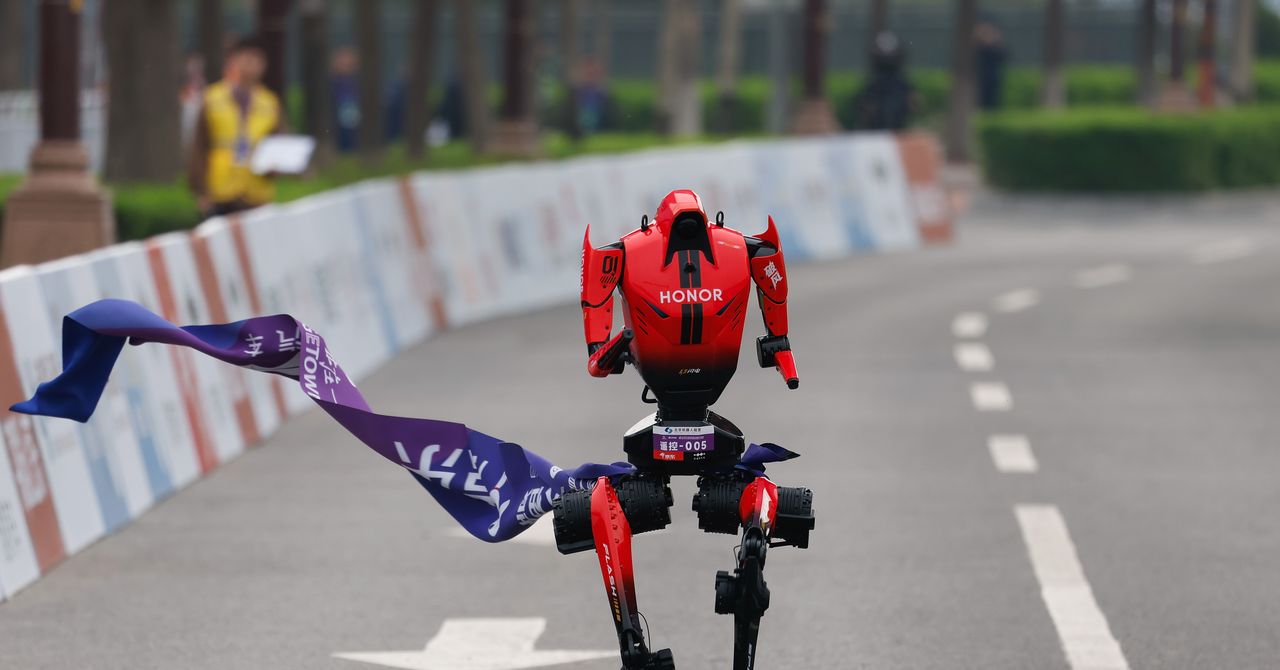
Over the weekend in China, a humanoid robot shattered world half-marathon record—the human record—by seven minutes.
The star performer was a robot developed by the Chinese company Honor (the smartphone maker), which finished the 13.1-mile race in 50 minutes, 26 seconds. The human record, set by Ugandan Olympic medalist Jacob Kiplimo, is 57 minutes, 20 seconds. The result marks an impressive milestone especially considering that, just a year earlier, the fastest robot at this half-marathon event took two and a half hours to complete the same distance.
But Honor’s robot was not the only participant. The event consisted of more than 100 humanoid robots from 76 institutions across China. The robots lined up alongside 12,000 human runners in Beijing’s E-Town, albeit on separate courses to avoid accidents. The contrast in performance between humans and robots was more than evident.
Run, Robot, Run
A humanoid robot is designed to mimic the structure and movement of the human body, with legs, arms, and sensors that allow it to interact with its environment. In this case, the winning robot incorporated features inspired by elite runners: long legs (almost a meter), advanced balance systems, and a liquid cooling mechanism, similar to that of smartphones, to prevent overheating during the race.
In addition, many of the participating robots operated autonomously, meaning without direct human control. Thanks to artificial intelligence algorithms, they could adjust their pace, maintain balance, and adapt to the terrain in real time. Notably, the Honor robot that achieved the 50-minute mark operated autonomously. The Chinese manufacturer presented another robot, operated by remote control, that ran the same stretch in even less time: 48 minutes, 19 seconds.
As expected, there were some accidents in the race. Some robots fell down, others veered off the path, and several needed technical assistance along the way. While the physical performance of humanoid robots has advanced rapidly, their reliability is still developing. Of course, the laughter and jeers are no longer as frequent as they used to be, replaced by applause and exclamations of surprise.
Robot Superiority
Just like the robots that went viral for their impressive martial arts display a few weeks ago, this long-distance race is part of a broader strategy by China to show off its leadership in the development of advanced robots.
You don’t need to be a robotics expert to see that this achievement demonstrates that machines can outperform humans at specific physical tasks under controlled conditions. (It’s hard to imagine that the winning robot could achieve the same result, for example, if it started to rain during the race.) But humans still have a few tricks up their sleeve: Running in a straight line is very different from performing complex real-world activities, such as manipulating delicate objects or interacting socially.
However, it’s understandable that the image of a robot crossing the finish line in record time, ahead of human athletes, raises several questions. Is this the beginning of a new era in which machines redefine physical limits?
One could argue that a car is a machine, and those have always been faster than humans. But a humanoid robot is designed to mimic humans. It’s more alarming to see one beat humanity at its own game—even if so many of them are still tripping over themselves.
This story originally appeared in WIRED en Español and has been translated from Spanish.