



An intriguing competitor
We don’t know everything about the Motorola Razr Fold, but we know enough to be excited. The folding phone will sport a large 8.1-inch main display with support for a stylus. It’ll also have a triple-camera system on the rear with 50MP sensors. The price, chip, and other key specs are still up in the air.
Pros
- 8.1-inch folding display is largest available in the U.S.
- Support for optional stylus (sold separately)
- Trio of 50MP rear camera sensors
- Classy design with PANTONE colorways
- Could undercut other foldables in price
Cons
- Many key specifications and pricing details unconfirmed
- AI Key could be better used for something else
- Motorola’s history of slow software updates could be a downside

Thin is in
The Samsung Galaxy Z Fold 7 set a new standard for foldable thinness, all while delivering faster performance and better features. The larger and wider cover screen is more enjoyable to use when the phone is closed, and key components, like the main camera, have been upgraded. However, it’s also more expensive.
Pros
- Crease is nearly invisible when using the phone
- Incredibly thin and light
- Same main camera as Galaxy S25 Ultra
- Uses fast Qualcomm Snapdragon 8 Elite chip
Cons
- Lacks S Pen support
- Expensive
- 16GB RAM exclusive to 1TB model
- Thin and boxy design makes it difficult to open
Motorola spent a few years reinventing itself, specifically in the clamshell foldable space. It’s trying to be a hip and fashionable brand, using partnerships with PANTONE and Swarovski to offer unique products. One thing we haven’t seen yet is a large Motorola Razr device, but we got our first look at one — the Motorola Razr Fold — at CES 2025. Motorola’s upcoming Razr Fold is its first stab at a big-screen foldable, and it’s already impressing us in a few ways.
The Razr Fold will face tough competition from the beginning, namely from the Samsung Galaxy Z Fold 7 (or the upcoming Z Fold 8, whenever it releases). Here’s how we expect the two folding phones to compare.
Motorola Razr Fold vs. Samsung Galaxy Z Fold 7: Design and displays

Motorola revealed the design and display of the Razr Fold at CES 2025, and it’s an attractive smartphone. When folded, the Motorola Razr Fold looks like a typical Motorola phone on the back. It has a two-tone look with a squircle-shaped platform for the cameras, housing three rear camera sensors and a flash. There’s also a Motorola logo on the back-center of the phone and the “razr” branding near the bottom.
The Motorola Razr Fold appears to have polished aluminum rails that accent the back panel. Instead of a typical frosted glass back color, Motorola is using unique materials on the Razr Fold in collaboration with PANTONE. There appear to be vegan leather back covers for the PANTONE Blackened Blue and PANTONE Lily White colorways. The phone’s corners are subtly rounded, but resemble the boxy Galaxy Z Fold 7 more than the curvy Pixel 10 Pro Fold.
We can gauge the general form factor of the Motorola Razr Fold from its screen sizes — there’s a 6.6-inch cover screen and an 8.1-inch main screen. However, Motorola hasn’t shared the exact dimensions for the device. We don’t know if it’ll be as thin as the Samsung Galaxy Z Fold 7, which set a new standard for foldable thinness this year.
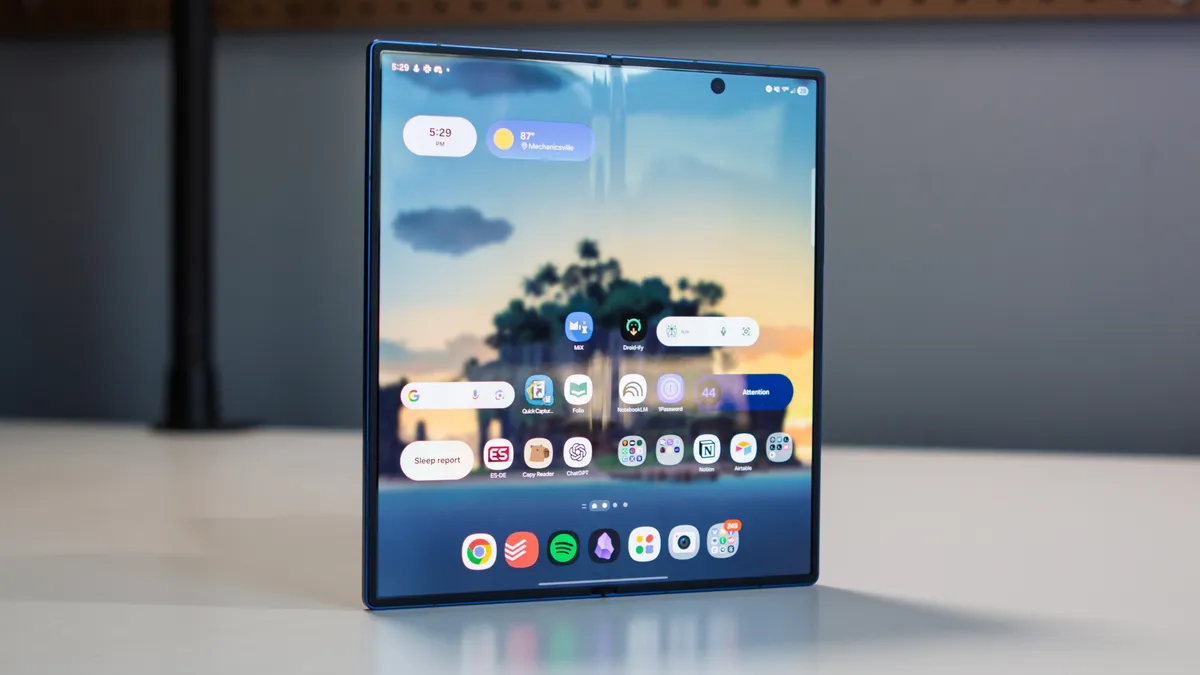
Specifically, the Galaxy Z Fold 7 measures just 8.9mm thick when folded. That’s only fractions of a millimeter more than the 8.2mm thickness of the non-folding Samsung Galaxy S25 Ultra. The more impressive spec might be that the Galaxy Z Fold 7 only weighs 215 grams. It does this while offering a premium hinge mechanism and meeting the IP48 rating for durability.
The main display on the Galaxy Z Fold 7 is an 8.0-inch foldable Dynamic LTPO AMOLED 2X panel with a 2184 x 1968 resolution and support for 120Hz refresh rates. Notably, Samsung dropped S Pen support from the Galaxy Z Fold 7 with this generation in an effort to make the display assembly smaller. The Motorola Razr Fold has the potential to offer better displays, with a slightly larger 8.1-inch panel and stylus support, but that could come in exchange for a thicker chassis.

As of now, we know the main Razr Fold display panel will use LTPO technology for variable refresh rates, and that it’ll have a 2K resolution. We also know that the cover display will be a 6.6-inch screen. Aside from that, though, most other design and display specifications for the Motorola Razr Fold are unconfirmed.
Motorola Razr Fold vs. Samsung Galaxy Z Fold 7: Hardware and specs

We presume that the Samsung Galaxy Z Fold 7 will have more polished hardware, as Samsung has been manufacturing foldable phones — especially large ones — for a long time. The crease on the Galaxy Z Fold 7’s folding display might be more subtle than the one on the Motorola Razr Fold. The overall hardware experience, from the processor to the build quality, might be to Samsung’s advantage.
It’s hard to tell for sure, though, because the underlying Motorola Razr Fold specs are unconfirmed. We expect the phone to support the latest Qualcomm Snapdragon 8 Elite Gen 5 chip with 16GB of RAM and up to 1TB of storage, but we don’t know that for sure. It’s unclear how Motorola would clock a Snapdragon 8 Elite Gen 5 chip on the Razr Fold, even if it gets one. We’re similarly in the dark on battery capacity and charging speeds on Motorola’s upcoming foldable.
In the specs table below, we’ve bolded the specifications that are officially confirmed, noted the ones that are expected but unconfirmed, and omitted those that are completely unknown.
|
Category |
Motorola Razr Fold |
Samsung Galaxy Z Fold 7 |
|---|---|---|
|
OS |
Hello UI/Android 16 (unconfirmed) |
One UI 8/Android 16 |
|
Display (internal) |
8.1-inch, 2K, LTPO |
8.0-inch, 2184 x 1968, 120Hz Dynamic LTPO AMOLED 2X |
|
Display (external) |
6.6-inch |
6.5-inch, 2520 x 1080, 120Hz Dynamic LTPO AMOLED 2X |
|
Chipset |
Qualcomm Snapdragon 8 Elite Gen 5 (unconfirmed) |
Qualcomm Snapdragon 8 Elite for Galaxy |
|
RAM |
16GB (unconfirmed) |
12GB/16GB |
|
Storage |
512GB or 1TB, UFS 4.1 (unconfirmed) |
256GB/512GB/1TB UFS 4.0 |
|
Rear Camera 1 |
50MP Sony LYTIA sensor |
200MP, Wide-angle, f/1.7, PDAF, OIS |
|
Rear Camera 2 |
50MP ultrawide/macro |
10MP, Telephoto, f/2.4, PSAF, OIS, 3x Optical Zoom |
|
Rear Camera 3 |
50MP 3x periscope telephoto |
12MP, Ultrawide, f/2.2, PDAF, 120-degree Field of View |
|
Selfie Camera (internal) |
20MP |
10MP, f/2.2, 24mm |
|
Selfie Camera (external) |
32MP |
10MP, f2.2, 18mm |
|
Audio |
Dual stereo speakers, Dolby Atmos, Snapdragon Sound (unconfirmed) |
USB-C, 32-bit/384kHz, Stereo Sound, Tuned by AKG |
|
Connectivity |
5G, Wi-Fi 7, Bluetooth 6, NFC, UWB (unconfirmed) |
Wi-Fi 7, Bluetooth 5.4, NFC, UWB |
|
Security |
Side-mounted fingerprint sensor, Face unlock (unconfirmed) |
Side-mounted fingerprint scanner |
|
Protection |
IP48 (unconfirmed) |
IP48 water and dust resistance |
|
Battery & charging |
— |
4,400mAh, 25W wired charging, 15W wireless, 4.5W reverse wireless, Qi2.1 |
|
Dimensions (open) |
— |
158.4 x 143.2 x 4.2mm |
|
Dimensions (closed) |
— |
158.4 x 72.8 x 8.9mm |
|
Weight |
— |
215 grams |
|
Colors |
Pantone Blackened Blue, Pantone Lily White |
Blue Shadow, Silver Shadow, Jetblack, Mint |
Since the Galaxy Z Fold 7 is available for purchase, we know exactly the kind of hardware and performance it offers. The phone is powered by the Snapdragon 8 Elite for Galaxy chipset, which is blazing fast. It comes with 12GB of RAM as standard, but you get 16GB of memory if you upgrade to the 1TB storage variant.
While not as fast as the newer Snapdragon 8 Elite Gen 5, the older Snapdragon 8 Elite is still very capable. Thanks to Samsung’s seven-year software update promise, the Galaxy Z Fold 7 has the hardware and software to last for years. Motorola’s software commitments and its ability to quickly deliver on them have been less consistent over the years.

The Samsung Galaxy Z Fold 7 has a 4,400mAh battery. This might be enough for all-day use depending on your habits, but people who use the main display often find they need a midday recharge. The phone charges at up to 25W via cable, 15W via Qi2.1 wireless charging (but lacks internal magnets), and supports 4.5W reverse wireless charging.
Motorola Razr Fold vs. Samsung Galaxy Z Fold 7: Cameras

The Samsung Galaxy Z Fold 7 is equipped with the flashier main camera sensor, but Motorola is poised to deliver the better overall camera array. Samsung put the same 200MP main camera sensor from the Galaxy S25 Ultra on the Galaxy Z Fold 7, which is a nice touch. It’s sharper than the 50MP Sony LYTIA sensor that will headline the rear camera system on the Motorola Razr Fold.
However, the rest of the camera system favors Motorola. The Razr Fold has a 50MP ultrawide and 50MP telephoto lens with 3x optical zoom support for its secondary cameras. Meanwhile, the Galaxy Z Fold 7’s secondary cameras are less impressive, offering just a 10MP ultrawide and 10MP telephoto.
Motorola will win the selfie camera battle, too, with a 20MP internal selfie camera and a 32MP external selfie camera. Samsung uses two 10MP selfie cameras on the Galaxy Z Fold 7. It’s worth noting that, with a foldable phone, you can use the rear cameras as a selfie camera for the best quality. This makes traditional selfie cameras less important.
Motorola Razr Fold vs. Samsung Galaxy Z Fold 7: Which should you buy?

Motorola is tight-lipped about many key specifications of the Razr Fold. We don’t know what chip it will use, how long its battery will last, or even how much it will cost. However, the company gave us just enough information to keep us intrigued. It’s set to introduce the largest inner screen of any foldable phone available in the U.S., and it’s adding stylus support at a time when other brands are removing it.
That said, it’s hard to ignore that Motorola faces an uphill battle with its entry into the large foldable market. The Samsung Galaxy Z Fold 7 is really good, and it’ll be hard for Motorola to match its thinness, premium feel, and durability in its first try. Adding to the difficulty is the timing of Motorola’s Razr Fold launch — it could arrive right before, or around the time of, Samsung’s Galaxy Z Fold 8 launch.
It’s entirely possible that Motorola’s first try at a large foldable could mimic Google’s entry into the space. The Google Pixel Fold was unimpressive in comparison to other foldables available at the time, but it quickly caught up to speed with the next Google Pixel 9 Pro Fold. In other words, we need to keep expectations reasonable for the Motorola Razr Fold. It’s a first-generation product, after all.
For those who want a great foldable Android phone today, the Samsung Galaxy Z Fold 7 is the clear winner. If you’re willing to wait for features like stylus support, the Motorola Razr Fold could win you over.
Something worth watching
It’s way too early to say whether the Motorola Razr Fold will be able to beat the Samsung Galaxy Z Fold 7. In fact, the Razr Fold might debut around the same time the Galaxy Z Fold 8 will be unveiled. With that being said, we already know some ways the Razr Fold will be competitive, like in display and stylus support.
The best right now
If you’re looking for a foldable phone today, there’s no question — the Samsung Galaxy Z Fold 7 is the best option available. It’s incredibly thin and lightweight, runs a modern OS with fast performance, and has all the features you need.
