



Follow ZDNET: Add us as a preferred source on Google.
ZDNET’s key takeaways
- Solar generators can help during weather emergencies.
- Prepare your setup before an emergency hits.
- Severe weather events are becoming more common.
Solar power stations are becoming all the rage. They’re finding their way into homes all across the country and being put to a multitude of uses, from harvesting solar energy to save money on power bills to creating a resilient power source that can cope with the increasing number of weather emergencies we are now having to endure.
Just the other day, I was reading about how a super El Niño could be something we have to contend with this year.
Also: How I boosted my portable solar panels’ power by up to 30% – 11 expert-approved tips
But power stations can themselves bring risks that might not be immediately obvious to owners, issues that can surface during an emergency, turning a bad situation worse.
Here, I’m going to outline some preparatory steps that you should take in order to get your solar generator ready for a weather emergency. I’ve been using solar generators for years, from portable setups that I’ve taken to off-grid locations to big setups that can power a home for days.
Also: Considering plug-in solar? My expert advice after setting up the DIY energy tech at home
I’ve also been an avid hiker, bushcrafter, and all-around outdoors person all my life, and I’ve taken a myriad of courses related to outdoor survival, from first aid and land navigation to urban emergency preparedness and the UK equivalent of SERE (Survival, Evasion, Resistance, and Escape), which over this side of the Atlantic is called Survive, Evade, Resist, Extract.
What’s your likely emergency?
Step one is knowing what kind of emergency you’re going to face, because that can change your approach. And the bad news is that you have plenty to choose from, depending on where you live:
- Midwest and Plains: Tornadoes, thunderstorms, and flooding.
- Southeast and Gulf Coast: Hurricanes, tropical storms, and flooding.
- West: Wildfires, droughts, and occasional winter storms.
- Northeast: Winter storms, blizzards, and occasional hurricanes.
- Coastal Areas: Hurricanes, storm surges, and rising sea levels.
Know the limitations of your equipment
Power stations are, on the whole, very safe pieces of equipment. I’ve spent many a day with one bouncing around the back of a truck or next to my head in a tent that’s slowly filling with water. But don’t lose sight of the fact that they are boxes that hold a lot of lithium-ion batteries and that can output thousands of watts of easily lethal AC power.
Also: I built my own Wi-Fi router with a Raspberry Pi for Starlink and solar control – here’s how
Power stations are designed to work optimally at room temperature — 68°F to 77°F (20°C to 25°C) — but are usually happy to charge in the range of 2°F (0°C) to 95°F (35°C) and discharge between 14°F (-10°C) and 104°F (40°C). As for moisture, this is where things can get dangerous, and it makes sense to treat a power station the same way as you’d treat an AC outlet or extension cable. Power stations are normally happy in humidity ranging from 0% to 60% when operating and up to 80% when being stored.
They also don’t tolerate water well, and unless the unit’s specifically designed to cope with water, any rain, spills, or flooding can damage internal components and cause a safety hazard.
The Bluetti AC60P was capable of shedding some serious rain!
Adrian Kingsley-Hughes/ZDNET
But there are more hazards to be aware of.
Fire is a big one, and it’s definitely something to think about, but worrying whether your power station has lithium-ion or the safer lithium iron phosphate (LiFePO4) batteries is somewhat moot as a wildfire is about to consume your property.
Also: Is plug-in solar legal in your state? How to check before setting one up at home
Wind can also become a serious issue, ripping solar panels off roofs or balconies, tearing wires, and turning 100-pound power stations into projectiles.
What to do before an emergency
Every situation is different, but here is my list of considerations to bear in mind:
- Keep a power station as cool and dry as you can. Some people keep them indoors, some in garages or workshops, and others put them in a small shed outside. Keeping the power station a couple of feet off the ground is a good idea in areas that are prone to light flooding, and putting it upstairs or in an attic space puts it in a real risk of serious flooding. In hot areas, keep the unit out of direct sunshine.
- Make sure that any solar panels you have are firmly fixedeven if you have a simple solar generator or plug-in solar setup. Wind can damage panels and wiring, and a 50-mile-per-hour wind will turn them into missiles that can damage property and cause injury.
Also: The solar-powered backup station I trust after years of testing – and why it works so well
- If your power station is bigger than the small portable units, consider getting a trolley to help you move it about. I’ve got plans to weld a trolley up for my Tower of Power to make it a little more mobile.
Wheels sure do make moving a heavy load easier!
Adrian Kingsley-Hughes/ZDNET
- If you live in an area where the power might go out for an extended period, you might want to consider pairing a solar generator with a propane or gas generator that will be able to offer a more robust, longer-term backup system. Make sure you familiarize yourself with how your generator works.
- Consider a cover for your power stationwhich can help keep it protected from dirt, dust, and splashes. There’s even a cover that you can get for keeping it outside.
- If you suspect that an emergency may happen in the following days, make sure that your power station is fully charged (use AC mains if need be), and consider packing away any solar panels. Here, it’s better to err on the side of caution, and if the emergency never materializes, consider what you did during a trial run.
Also: Avoid these 8 solar mistakes that cut your power output in half – I learned the hard way
Tip: It’s a good idea to get all your important documents safe. I recommend getting a waterproof/fireproof lockbox or safebecause lost paperwork can be a real pain to replace.
What happens during an emergency
OK, things are starting to get serious. The preparations are done, and it’s now time to step up a gear. Here’s what my game plan would be:
- Use any time you have to charge the power station and all your devices.
- Tune into local weather and news. Be alert for any evacuation warnings. Get an idea of how long the main part of the emergency might last. For wildfires, keep a careful note of wind direction, and for flooding, it’s a good idea to move vital items — including your power station and other electronics — from the ground floor.
- Once the charging is done (or the weather emergency is imminent), disconnect the power station from the mains power (this protects it against power surges and lightning zaps).
- Don’t waste your power station’s reserves. Prioritize essentials such as refrigerators, medical devices, communication tools (smartphones, radios), and lighting.
- Listen for whatever instructions you are given by local authorities or emergency services.
- Remember that once the emergency is over, the risks are not. Flooding, building damage, overflowing sewers, downed power lines, and broken gas mains are just some of the dangers that might come after a weather emergency.
And after the emergency?
Congratulations, you survived.
Now there are two possibilities going forward.
The best outcome is that the emergency has passed, and things are pretty much back to normal, or close to it, and there’s just a bit of cleanup to do. You can expect things to get back to normal pretty quickly.
Also: I spent two years testing wind power at home – here’s why solar is still my preferred source
The other option is that the primary emergency has passed, but it’s left secondary havoc in its wake, which could take days, weeks, or more to sort out, depending on the scale of the damage.
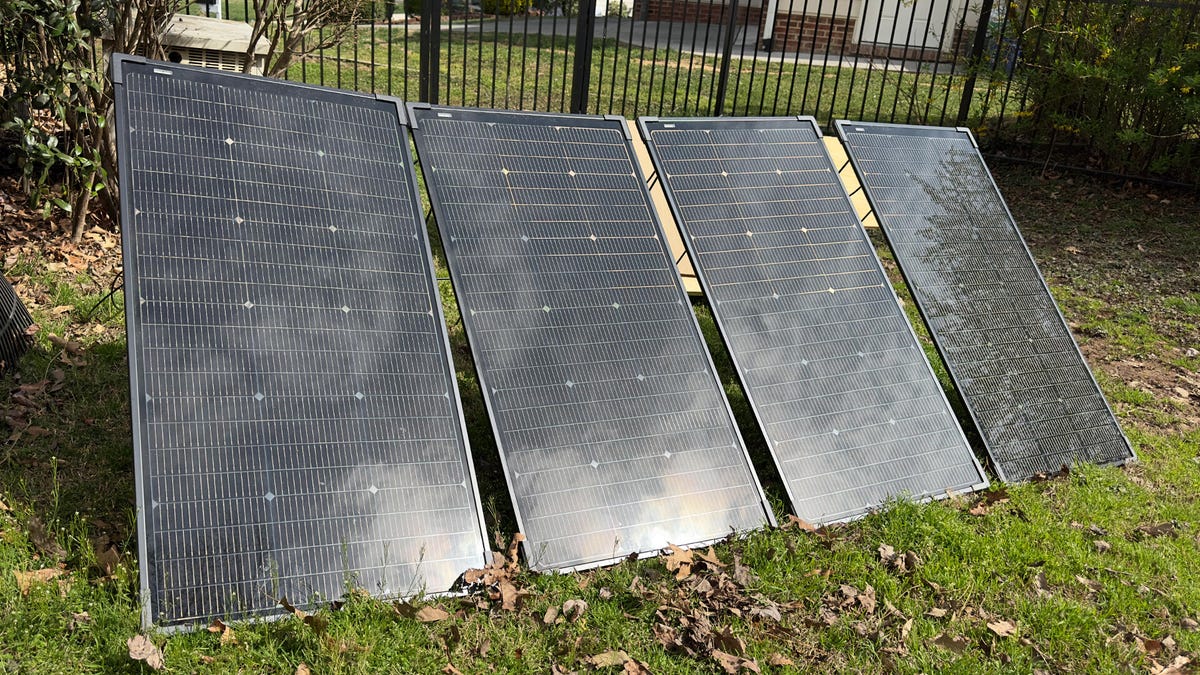
Get the solar panels working as soon as it’s safe to do so.
Adrian Kingsley-Hughes/ZDNET
If your property is mostly undamaged, but AC power isn’t flowing from the outlet, you need to be thinking about keeping the power station’s reserves up. Work on conserving power, focusing on essentials. Also, you need to be thinking about getting power into the batteries, either by getting the solar panels going again or firing up the generator.
And if you are using the generator, fuel might be limited, so use it sparingly to recharge batteries.