


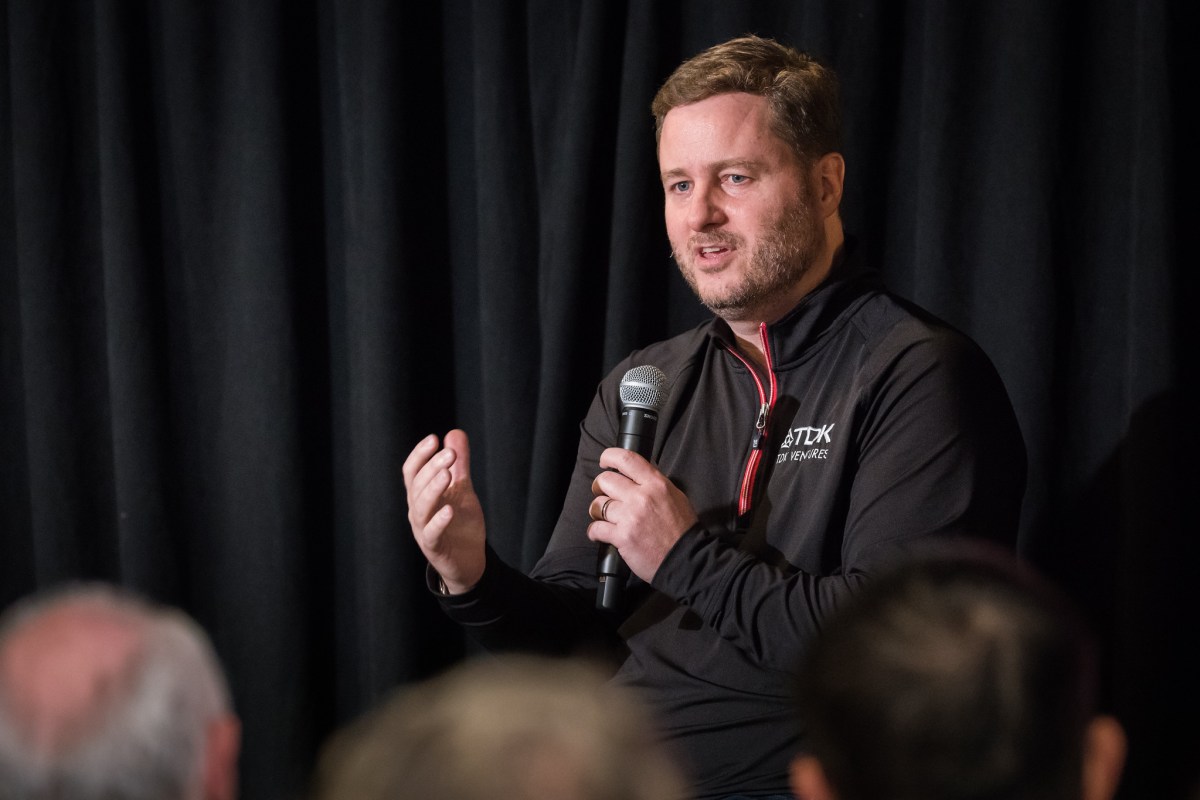
Nicolas Sauvage believes it takes four years for the best bets to look obvious — thinking that he shared on stage last week at StrictlyVC’s San Francisco event, which TDK Ventures co-hosted.
It’s a theory he’s been working to prove since 2019, when he founded the corporate venture arm of the Japanese electronics giant, which is now managing $500 million across four funds. The AI chip startup Grokvalued at $6.9 billion during its most recent funding round last fall, is the highest-profile example of this thinking.
In 2020, well before the generative AI boom made infrastructure bets look obvious, Sauvage wrote a check into the company, which was founded by Jonathan Ross — one of the engineers who built Google’s Tensor Processing Units. Groq was focused from the start on inference: the computational heavy lifting that happens every time a model responds to a query. Ross had designed his chip by building the compiler first, stripping the architecture down until, as Sauvage describes it, “you can’t remove one part and have it still work.”
It might have looked niche to some, but knowing what he did about his parent company’s constraints, Sauvage saw asymmetry. Unlike consumer hardware, which has a natural ceiling, demand for inference keeps compounding with every new application and every new model. Sauvage couldn’t know then that demand for inference would explode this year, thanks to every AI agent that plans and acts across dozens of calls (where a single query used to suffice).
But in some ways, Ross got lucky, too. After all, a Japanese electronics conglomerate best known for magnetic tape is not, on its face, the most obvious investing partner. In fact, Sauvage describes TDK Ventures’ own existence as very unlikely. But after two back-to-back Stanford lectures — one making the case for corporate VC, one cataloguing every reason it fails — Sauvage, who is French and joined TDK in Silicon Valley through an acquisition, pitched the idea to higher-ups at TDK headquarters despite having no obvious standing to do so. (“I’m not Japanese. I don’t speak Japanese; I don’t live in Tokyo,” he told this editor.)
After refusing to take no for an answer, he finally received the green light in to build a fund whose mandate was to answer one question: What’s the next big thing for TDK, and what might kill it?

The portfolio he has since assembled is dotted with technologies that have become more widely interesting to VCs over the last year: solid-state grid transformers, sodium-ion batteries for data centers, alternative battery chemistries that sidestep the geopolitical fragility of lithium and cobalt.
Techcrunch event
San Francisco, CA
|
October 13-15, 2026
The discipline behind all of it is the same: identify the bottleneck four years out, then find the founders already working on it.
The question, of course, is what’s next. For his part, Sauvage is watching physical AI closely — not all of robotics but robots with a highly specific job to be done. Agility Roboticsfor example, in his portfolio, focuses on the single, mundane task of moving things from one place to another in warehouses facing workforce shortages. Another portfolio company, Swiss portfolio ANYboticsbuilds ruggedized robots for environments too hazardous for human workers — places where the job definition is essentially to go where people can’t. The through-line is clarity of purpose. The robots Sauvage is betting on don’t try to do everything; instead, they do one hard thing reliably.
Sauvage says he’s also watching the compute stack shift again. GPUs dominated training — the massive, parallel computation of teaching a model. Inference chips like Groq’s are reshaping what happens when that model speaks: faster, cheaper, at scale. Now, Sauvage argues, CPUs are due for a renaissance. They’re not the most powerful chips or the fastest. But they’re the most flexible and best suited to the branching, decision-making logic of orchestration. When an AI agent delegates a task, checks on its progress, and loops back across dozens of steps, something has to manage the whole choreography. That something, increasingly, looks like a CPU.
And then there’s China. A recent report from Eclipse — a venture firm he follows closely — documented what Sauvage describes as “vibe manufacturing” — the rapid, AI-assisted iteration of physical hardware prototyping, mirroring what vibe coding did for software. Chinese manufacturers, the report found, are compressing the design-build-test cycle for physical products in ways Western supply chains aren’t yet equipped to match.
For Sauvage, it’s a bottleneck signal — and one he’s already moving on with TDK Ventures’ various investments. One remaining unsolved problem, he says, is dexterity. Models are improving fast enough that physical AI feels inevitable; what’s still missing is the physical fluency to match. The countries and companies that figure out how to iterate on atoms as fast as others iterate on code will have a manufacturing advantage. That’s the wave for which he’s positioning TDK Ventures today.
When you purchase through links in our articles, we may earn a small commission. This doesn’t affect our editorial independence.